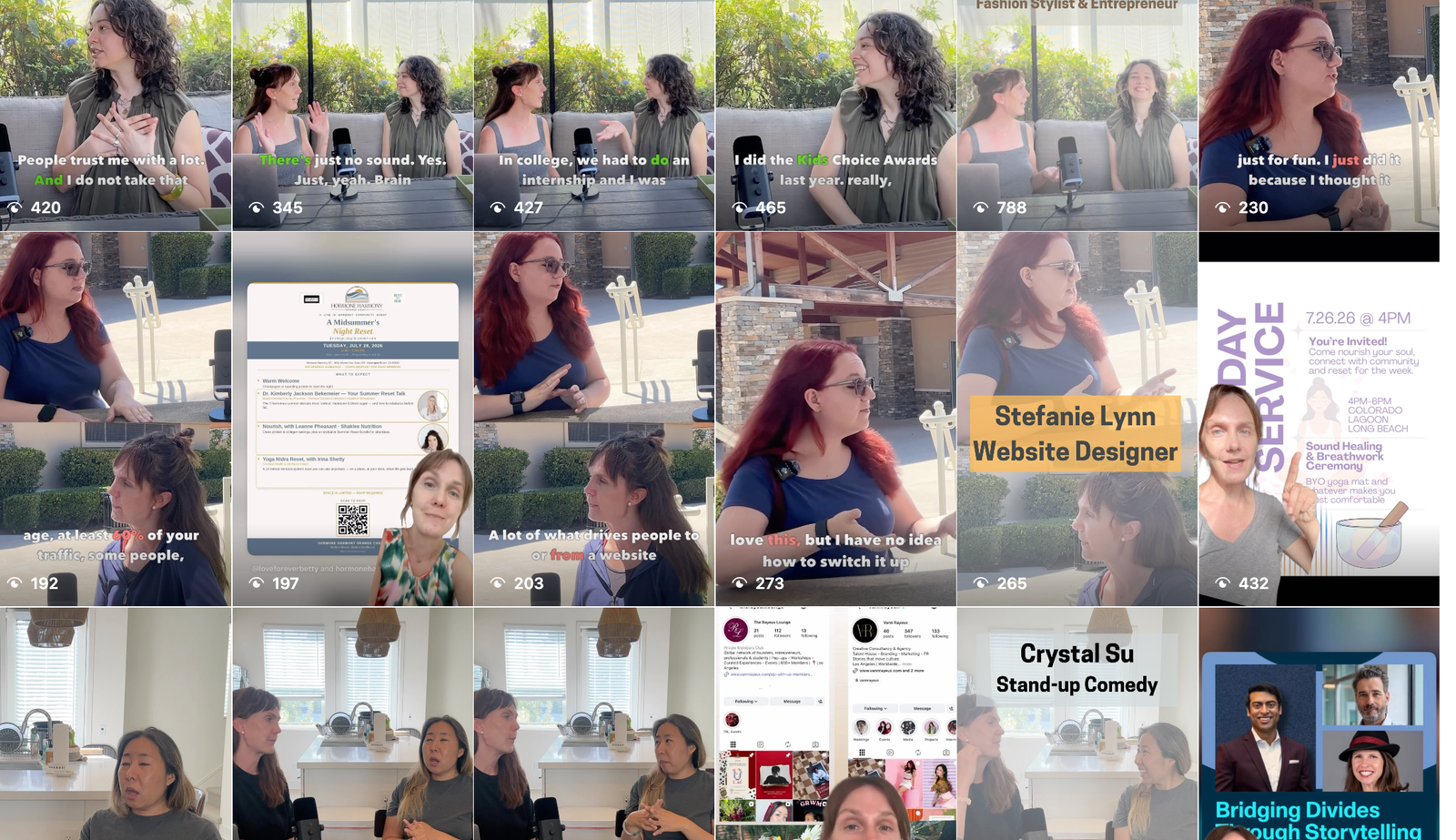
Back in March, I had the privilege of interviewing Dr. Kimberly Bekemeier of Hormone Harmony OC.
She told me about how she kept running into a gap: the space between childbirth and the first hot flash. Dr. Kimberly Bekemeier noticed this first as a patient, then as a physician watching her own patients fall into the space of not knowing what came next.
Started From a Group Chat
The beginning of Hormone Harmony started in a neighborhood group chat with other moms.
“Who has ever talked about hormones? Should we be talking about hormones? Who do you go to?” someone asked. It was a question no one had an easy answer to.
As a board-certified family physician and certified life and wellness coach, as well as Menopause Society Certified, Kimberly had already spent her career seeing healthcare from both sides of the exam table. But this gap felt different. It wasn’t a missing specialist. It was an entire life stage nobody had built care around.
“There’s prenatal care. If you decide to have a family, there’s postpartum care. And then there’s this big lull,” she explains. “Then you hit 65, elderly, and we pick back up. But that middle, when you’re done having kids, you’re not yet in that geriatric age, there’s just this drop.”
Women’s Health Gets Left Behind
I asked her why this might be, to which she replied, “We were not taught it in med school. Studies traditionally have been done for men. Drugs that come out have been studied for men. Women’s health is kind of on the back burner.”
And midlife, she points out, is exactly when women have the least bandwidth to fight for better care. “We’re the doers. We don’t have the time. And if someone’s not coming up with that healthcare information, we’re not going out and seeking it, because it’s so limited.”
What’s changing, she says, is that women are finally asking the question out loud: “…Is this normal? Why am I feeling this way?”
“A third or more of your life is spent after menopause,” Kimberly says. “Once that reality comes up, we’re starting to demand more care as women.”
The Building of Hormone Harmony OC
The core problem Kimberly identifies isn’t a lack of information; it’s a lack of time. She went on to explain that in a traditional insurance-based practice, visits cap out around 15 minutes. “That doesn’t lend itself to a woman whose hormones are changing each week, especially once you add on anything chronic, aging, raising children, aging parents.”
Hormone Harmony OC runs on a concierge membership model. The practice is set-up so that patients get timely access and visits long enough to actually be heard. “We’re not checking boxes. We’re not being told we have to meet certain metrics. We can really care for the person in front of us.”
She also created the practice so that it’s built around flexibility. Virtual visits are available for those who are unable to make it directly into the office based in Huntington Beach, CA. Meanwhile, the in-person visits happen in a space designed to feel less like a doctor’s office and more like an extension of the care itself. “There’s still something very human about sitting in close proximity, being able to actually see someone,” she says.
Women Entering Their 40s
“Don’t wait for symptoms to become impossible to ignore.”
“Menopause is typically around 50. Back that up a decade, and that’s about 40.” Some women start noticing changes as early as 35. She advises that by 40, it’s important to start asking questions, paying attention to symptoms, and seeking out care. This will allow you a full decade to prepare.
She explained to me that hormones affect nearly every organ system, and ignoring them carries real long-term risk. There’s bone density loss, cardiovascular risk, and the kind of fragility fractures that quietly end someone’s independence.
“It’s about prevention. Let’s not wait until we’re 65 or 70 and have something devastating happen. Let’s strengthen and prevent now, so we’re set up to be active well into our 40s and 50s.”
More Than a Medical Practice
The part that Kimberly is the most excited about is the community she’s building around the practice. She went on to explain that she wants to create a space that offers yoga on the beach, hormone talks over happy hour, and informal gatherings in the spaces women already occupy.
“I think one of the biggest things is: when we feel isolated, that’s when it’s hard to change, hard to get care,” she says. She wants to create a space where women leave a conversation thinking, “Oh my gosh, you too? We should go meet for coffee.”
Hormones, she points out, touch some of the most private parts of life. Think mood, weight, sleep, and intimacy. Things that carry an unspoken “is something wrong with me?”
“It takes a lot of vulnerability to ask those questions,” she says. “If you don’t have older women in your life who make those conversations okay, there’s guilt, shame, all those feelings that come up.”
Her goal isn’t just to treat symptoms; it’s to send women out into the rest of their lives more able to advocate for themselves. “Let’s create a path that’s sustainable for you, and most importantly, let’s get you comfortable advocating for yourself. Knowing what to ask, whether that’s in a healthcare space, your personal life, or your professional life.”
Getting in Touch
Hormone Harmony OC opened its doors June 1st and offers both in-person and virtual visits for women in Orange County (with virtual consults available for women without local access to this kind of care).
Hormone Harmony offers a full signature membership that includes all things PCP and urgent care. Dr. Kimberly Bekemeier has also added a hormone membership for the women who need that aspect dialed in, without everything else, especially in the perimenopause period.
To learn more, visit hormoneharmonyoc.com